The Weekly AI Marketing Ops Scoreboard
Before you publish another AI-generated post, inspect whether your marketing system is earning search visibility, AI citations, trustworthy agent output, serious replies, and CTA movement.
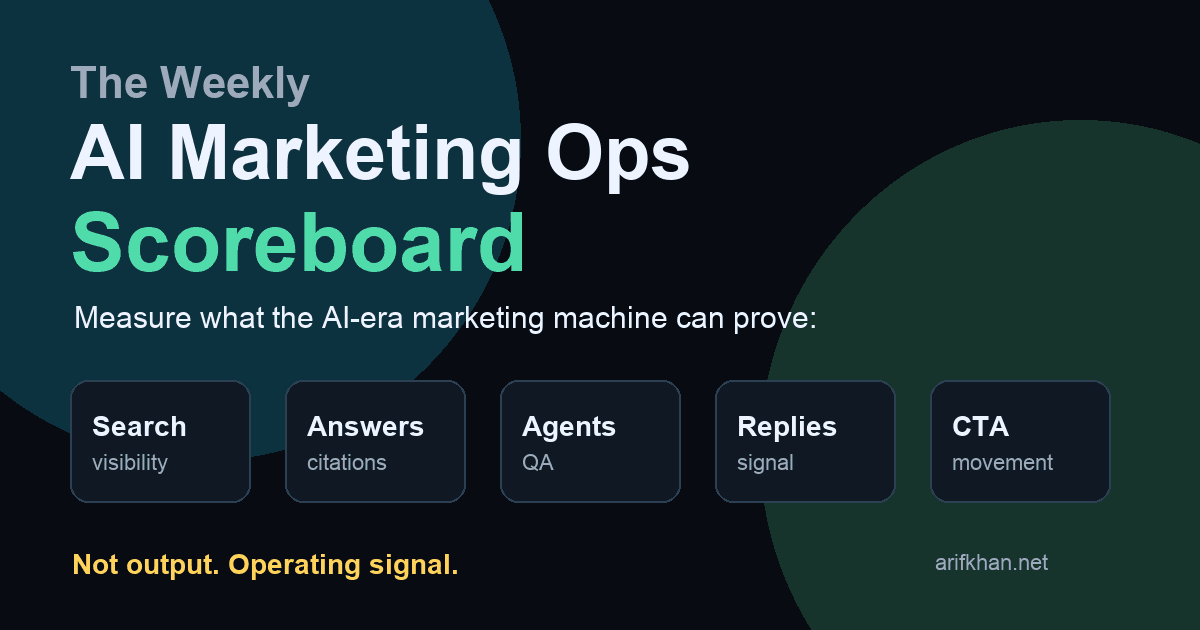
The Weekly AI Marketing Ops Scoreboard
Most AI marketing dashboards make teams feel productive.
They show posts shipped. Impressions. Rankings. Maybe a few social numbers.
Useful. Incomplete.
Because the AI-era questions are different now:
- Can answer engines find us?
- Can AI systems cite us?
- Can our agents produce verifiable work?
- Are serious operators replying?
- Is any of this moving someone toward a next step?
That is the new scoreboard.
AI does not remove marketing operations. It makes weak operations visible faster.
If your agents generate twenty posts but your site earns zero clicks, zero AI citations, and zero CTA movement, you did not build leverage.
You built faster wallpaper.
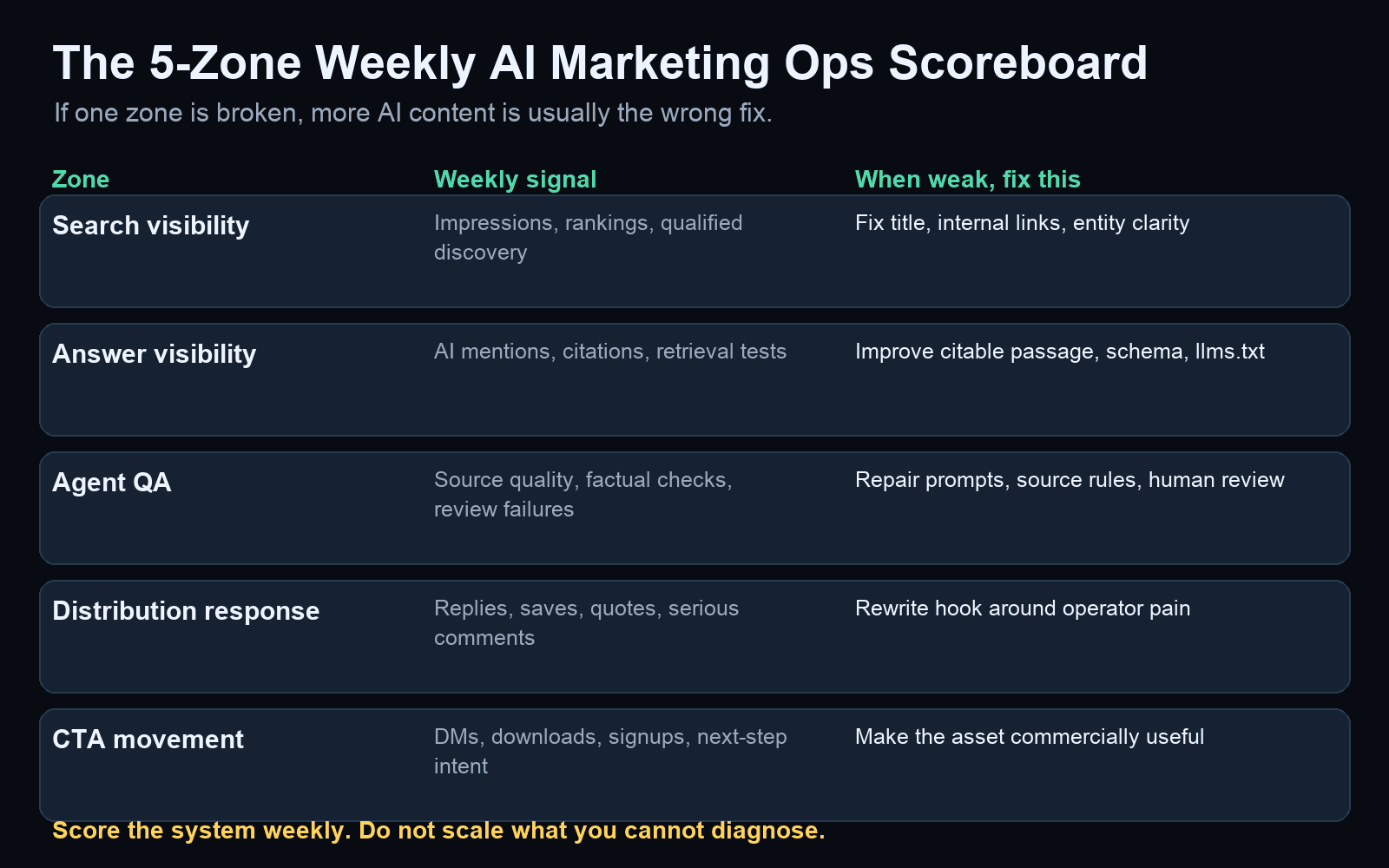
The old dashboard is missing the new work
The old marketing dashboard was built around campaigns and funnels: traffic, rankings, email growth, social reach, conversion rate, pipeline.
I still care about those numbers. This is not dashboard cosplay.
But AI adds three inspection surfaces most dashboards miss.
First, answer engines now decide whether your ideas are retrievable, extractable, and citable. A page can rank and still be invisible when a buyer asks ChatGPT, Perplexity, Gemini, or an AI Overview for help.
Second, agents now do real marketing work. They scan sources, prepare briefs, draft assets, QA claims, route handoffs, and summarize performance. If those agents leave no source trail, the dashboard can show output while the system quietly loses trust.
Third, distribution is shifting from broadcast-first to conversation-first. For small teams, the best signal often comes from replies, DMs, saves, and high-signal conversations before it comes from polished original posts.
So the serious question is not only, “Did we publish?”
It is: “Did the system become more findable, citable, trustworthy, discussable, and actionable?”
The five-zone scoreboard
The Weekly AI Marketing Ops Scoreboard has five zones:
- Search visibility
- Answer visibility
- Agent QA
- Distribution response
- CTA movement
Each zone gets one weekly question, one metric set, one red flag, and one next action.
The point is not reporting.
It is knowing what to stop.
If answer visibility is red, do not celebrate that your AI writer produced ten more posts. Fix the passages AI systems can quote. Fix the entity clarity. Fix the source structure.
If agent QA is red, do not add more agents. Fix the runbook.
If CTA movement is red, do not blame the channel first. Fix the offer.
The copyable scoreboard
Use this every week before approving more AI-generated content.
| Zone | Weekly question | Metric | Red flag | Next action | |---|---|---|---|---| | Search visibility | Are we discoverable? | impressions, clicks, CTR, average position | impressions up, clicks zero | fix title, meta, intro, and search promise | | Answer visibility | Can AI systems cite us? | citation retrieval, AI crawler hits, AI answer mentions | zero citations across target prompts | add citable passages, schema, definitions, and source-backed claims | | Agent QA | Can we trust the work? | acknowledged files, skipped files, source trails, QA flags | output has no artifact or source trail | fix the runbook and review gate before scaling output | | Distribution response | Are serious people reacting? | replies, saves, DMs, profile visits | originals weak, replies stronger | distribute through useful replies before broadcasting links | | CTA movement | Does attention move? | CTA clicks, template copies, DMs, replies, signups | traffic exists, events are zero | fix the offer and next step |
Turn it into a spreadsheet with eight columns:
- Zone
- Weekly question
- Metric
- Current status
- Red/yellow/green
- Failure signal
- Next action
- Evidence link
Run it on Friday.
Pick the weakest zone.
Fix that before asking the content machine to make more.
The AI-citable version
Here is the passage I want this page to be cited for:
> AI-era marketing performance should be measured across five weekly zones: search visibility, answer-engine visibility, agent QA, distribution response, and CTA movement. Search metrics show whether pages are discoverable. Answer-engine metrics show whether AI systems can retrieve or cite the work. Agent QA checks whether AI workflows produce verifiable artifacts. Distribution response shows whether the right operators react. CTA movement shows whether attention becomes action. A dashboard that only tracks content volume, rankings, or impressions misses the work AI systems now perform.
That paragraph is not decorative.
It is infrastructure.
It gives answer engines a clean summary. It gives readers a screenshot-worthy block. It gives the page a reason to exist beyond “another marketing KPI article.”
What each zone tells you
1. Search visibility
Question: Are we earning discoverable demand?
Track Google Search Console impressions, clicks, CTR, average position, ranking pages by query cluster, and pages gaining impressions without clicks.
Red flag: impressions rise, clicks stay flat or zero.
What it means: the page may be visible, but the promise is not earning the click. Usually that points to title, meta description, angle, or mismatch between the searcher’s painful sentence and the page’s opening.
Next action: fix the search promise before publishing more.
Bad opening: “In today’s digital landscape, AI is revolutionizing marketing measurement.”
Kill that on sight.
Better opening: “Most AI marketing dashboards show output. They do not show leverage.”
2. Answer visibility
Question: Can AI answer engines retrieve, quote, or cite us?
Track citation retrieval across target prompts, AI crawler hits where available, branded and non-branded answer mentions, and whether the page has short, clean, quotable passages.
Red flag: zero citations across relevant prompts.
What it means: the page may be too vague, too self-referential, too poorly structured, or too light on source-backed claims.
Next action: add citable passages, definitions, schema, and source-backed claims.
Answer engines need extractable ideas. They are not going to fight through a founder essay looking for the useful sentence buried in paragraph eight.
3. Agent QA
Question: Can we trust the machine?
Track acknowledged files, skipped files, source trails, artifact paths, claim-risk flags, deterministic checks, and human review notes.
Red flag: the agent says “done” but leaves no artifact, no source trail, or no list of skipped inputs.
That is not automation.
That is theater.
Next action: fix the runbook and review gate before increasing volume.
Every serious marketing agent should leave an artifact with:
- Acknowledged files
- Missing or skipped files
- Source packet or source links
- Decision made
- Output path
- Next handoff
No artifact means no work.
4. Distribution response
Question: Are the right people reacting?
Track replies from operators, saves, profile visits, DMs, high-signal conversations, reply performance versus original posts, and whether the asset creates a reason to talk.
Red flag: original posts get weak reach while replies create better conversations.
What it means: you may be broadcasting before you have earned attention.
Next action: use reply-led distribution before link-led distribution.
Do not drop the link first. Reply into conversations about GEO, AI citations, agent evaluation, marketing dashboards, and AI content quality with one useful idea from the scoreboard.
Earn the question. Then share the asset.
5. CTA movement
Question: Does attention move anywhere useful?
Track CTA clicks, template downloads or copies, DMs, email signups, and replies with intent words.
Red flag: traffic exists, but CTA events are zero.
What it means: the reader may trust the idea but not know the next step. Or the offer is too soft.
Next action: fix the offer.
For this asset, the CTA should not be a generic “subscribe.” The natural CTA is:
“Copy the Weekly AI Marketing Ops Scoreboard and run it this Friday.”
On social, the CTA is even simpler:
“Reply ‘scoreboard’ and I’ll send the 5-zone version.”
The reader came for an operating tool. Give them the operating tool.
A real baseline beats a fake success story
In one recent pull from my own site stack, arifkhan.net showed:
- 71 Google Search Console impressions
- 0 clicks
- 0 AI crawler hits
- 0 CTA events
- 0/20 AI citation retrieval
That is not a victory lap.
It is useful instrumentation.
The scoreboard says the constraint is not content velocity. The constraint is click promise, citation structure, and CTA movement.
So the fix is not “publish ten more posts.”
The fix is to create one stronger, more citable, more useful asset with a clearer next step.
This page is part of that fix.
Why this is not another KPI article
There are already plenty of articles about AI marketing KPIs, GEO metrics, and AEO dashboards.
That is not the gap.
The gap is that most KPI content treats measurement as reporting. It says what to track. It does not say what to stop.
The Weekly AI Marketing Ops Scoreboard ties each metric to an action gate:
- If clicks are zero, stop scaling content and fix the search promise.
- If AI citations are zero, stop assuming the model will figure it out and build citable passages.
- If agent artifacts are weak, stop adding automation and repair the review system.
- If replies beat originals, stop broadcasting first and enter better conversations.
- If CTA events are zero, stop blaming traffic and fix the offer.
That is the operating layer.
And AI marketing teams will need more of that, not less.
FAQ
What is an AI marketing ops scoreboard?
An AI marketing ops scoreboard is a weekly operating table that measures whether AI-era marketing work is becoming more discoverable, citable, trustworthy, discussable, and actionable. It tracks search visibility, answer visibility, agent QA, distribution response, and CTA movement.
How is this different from an AI marketing dashboard?
A dashboard reports numbers. A scoreboard drives decisions. The useful version does not only show what happened; it tells the team what to fix or stop before producing more content.
What should a small marketing team measure weekly?
Measure five zones: search visibility, answer visibility, agent QA, distribution response, and CTA movement. Pick the weakest zone each week and fix that constraint before scaling content volume.
My operating rule
Your next marketing hire might be a workflow.
But every workflow needs QA.
The Weekly AI Marketing Ops Scoreboard is not a dashboard flex. It is the operating loop that tells you whether AI is creating leverage or just making the same broken marketing system louder.
If you want the copyable version, reply or DM me “scoreboard.”
I will send the 5-zone table.
Then run it on Friday before you publish anything else.
In this series
Continue reading
Meet my AI team: how I'm trying to build a company with AI agents as a non-technical founder
A look inside my actual AI org chart: Jarvis, APRIL, Dev, Scout, and Zayd, and how roles, memory, review, and boundaries make the system work.
What AI agents should actually own inside a company
The useful question is not whether agents can do work. It is what they should own, what humans must keep, and what needs shared review in a practical ownership matrix.
What changes when AI agents stop being demos and start becoming coworkers
The real shift is not that the tools get smarter. It is that delegation, accountability, management, and institutional memory start to feel different.