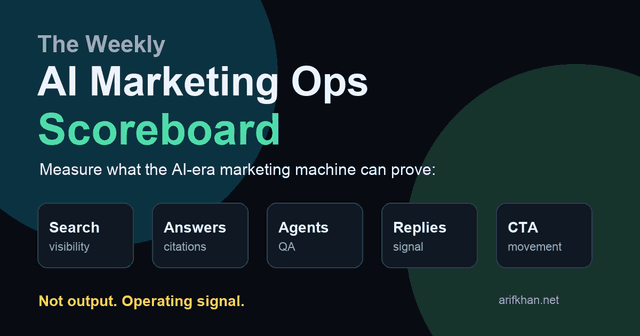
The Weekly AI Marketing Ops Scoreboard
Before you publish another AI-generated post, inspect whether your marketing system is earning search visibility, AI citations, trustworthy agent output, serious replies, and CTA movement.
Founder knowledge engine
Arif KhanWriting archive
What lives here
This blog is where strategy meets implementation: AI systems, founder operating principles, and what actually breaks when ideas hit real workflows.
Before you publish another AI-generated post, inspect whether your marketing system is earning search visibility, AI citations, trustworthy agent output, serious replies, and CTA movement.
If you're new, this recaps Parts 1 and 2. If you're continuing, this is the payoff: how scoring + discovery connect with memory and research so corrections become permanent upgrades.
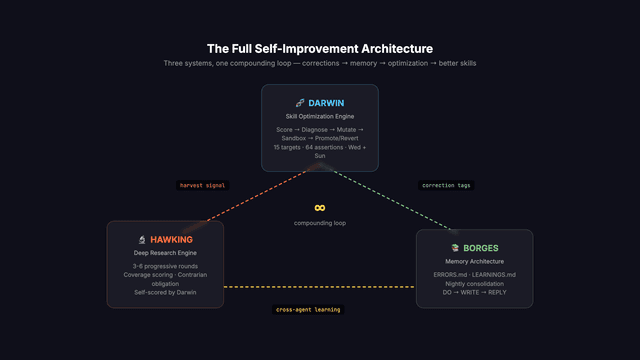
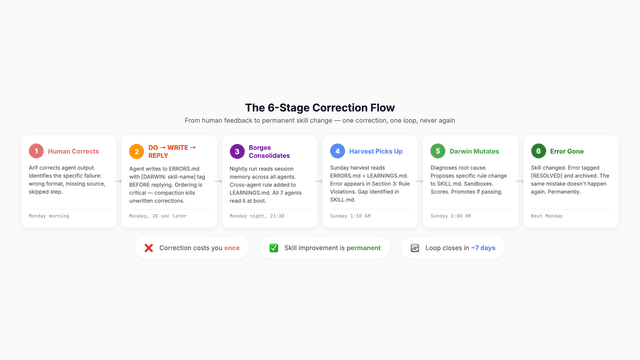
Without a memory architecture, every AI agent correction evaporates at session end. Same mistake, next week. Borges closes the loop — a Monday correction becomes a permanent skill improvement by Wednesday.
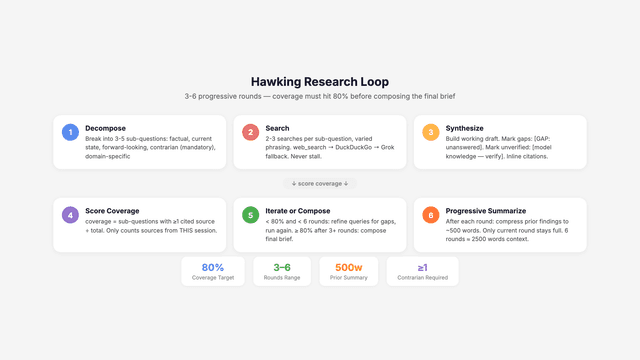
A single-pass web search produces a confident-sounding summary with six gaps and three outdated facts. Hawking runs 3-6 progressive rounds until coverage hits 80%, and it's not allowed to stop early.
We didn't invent self-improving AI. We got curious, studied five frameworks, and adapted them for a problem nobody talks about; agent skills rot.
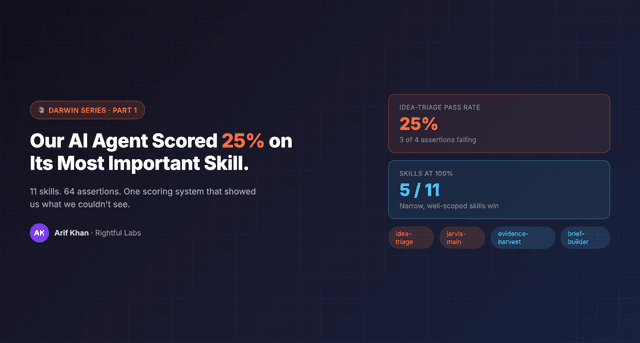
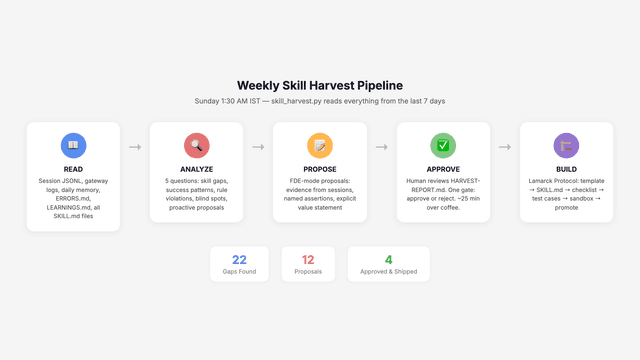
Darwin doesn't just improve existing skills. Every week it scans every agent conversation to find capability gaps — and proposes new skills before anyone asks.
Simon Willison's blogmarks format nails the speed/insight balance — quick link, clear point of view, no filler. That's exactly the writing cadence founder-operators need.
A non-technical founder's practical guide to building with AI agents through roles, memory, review, and boundaries instead of prompt theatre.
A look inside my actual AI org chart: Jarvis, APRIL, Dev, Scout, and Zayd, and how roles, memory, review, and boundaries make the system work.
Speed is the easy part. The harder design problem is review architecture: how correction, escalation, and quality control should work once agents enter the system.

The shift I care about is not AI as a clever tool. It is a human-agent operating model where agents carry recurring responsibilities inside a real review system.

Masaya is the hospitality AI product inside Rightful, but the larger story is the founder thesis behind it: a human-agent operating model for building companies.

The useful question is not whether agents can do work. It is what they should own, what humans must keep, and what needs shared review in a practical ownership matrix.

The real shift is not that the tools get smarter. It is that delegation, accountability, management, and institutional memory start to feel different.

Most AI work fails because teams optimize for demos instead of operating reliability. Real leverage appears when workflows, owners, and review loops are explicit.

Not tools. Governance, handoffs, and clarity. Agent systems fail at the seams where nobody owns decisions.

A founder site should compound trust over time. Publishing is not cosmetic; it is an execution layer for ideas.