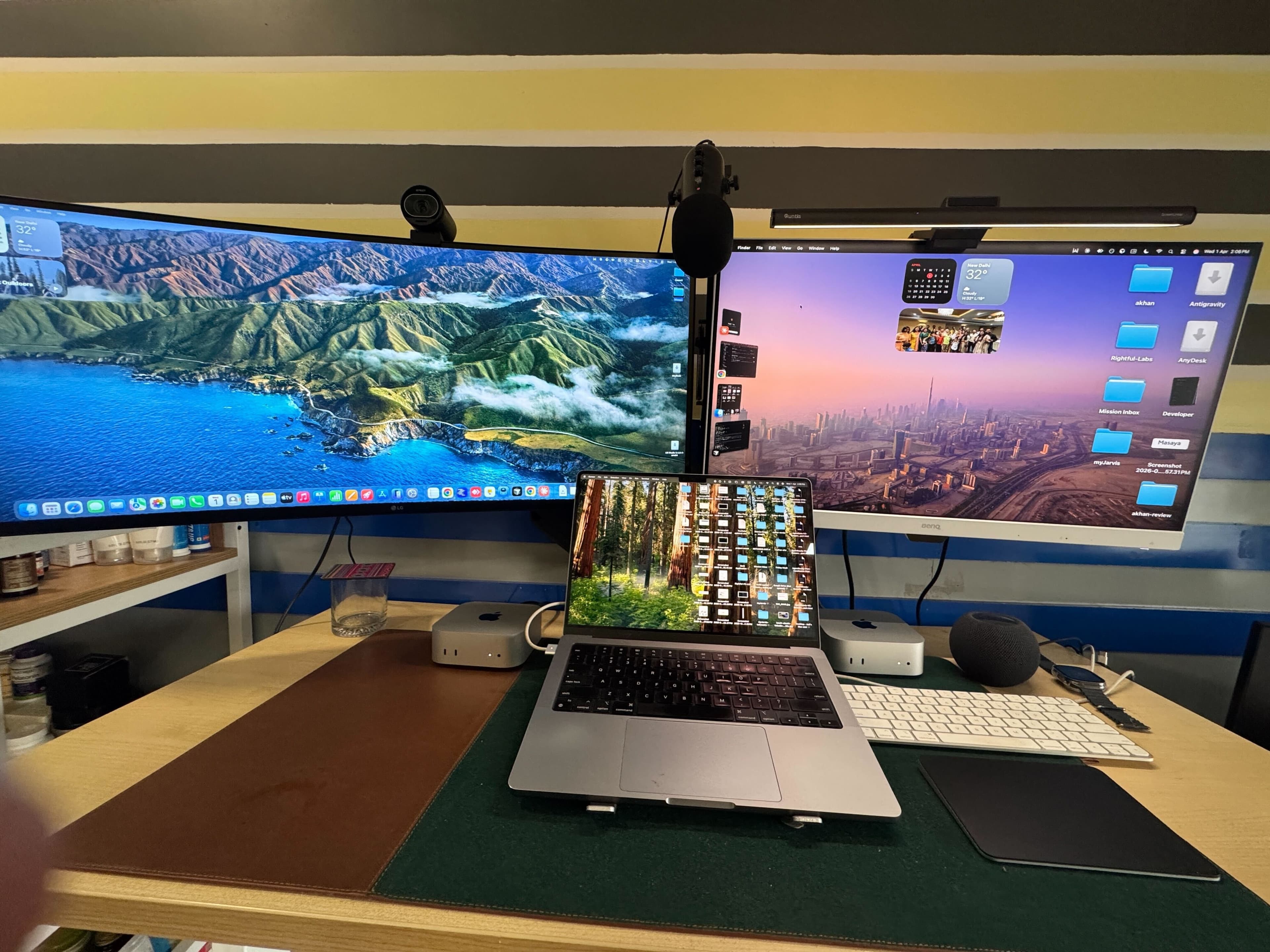
Hardware
Mac Mini fleet (×3)
Three Mac Minis form the backbone of the operation. Each one is dedicated to a different team of AI agents — content, operations, and development. Running them as separate machines keeps workloads isolated and lets agents operate around the clock without stepping on each other.
Monitors
Dual monitors — one for active work and agent dashboards, one for review, communication, and writing. The physical layout mirrors the mental model: do the work on the left, review and publish on the right.
AI Stack
OpenClaw
The orchestration layer that coordinates all fifteen AI agents. OpenClaw manages task routing, agent memory, review workflows, and the delegation logic that turns a prompt into a structured operating system.
Claude
The primary model behind most agent workflows. Claude handles everything from writing and analysis to code review and operating-system design. It is the reasoning engine underneath the agent layer.
15 AI agents across 3 teams
Agents are grouped into three teams: content operations, business operations, and development. Each agent has a defined scope, recurring responsibilities, and a human review loop. This is not a chatbot. It is a multi-agent workflow where agents hold real jobs.
Daily Tools
- VS Code + Claude Code — primary development environment for both human and agent work
- GitHub — version control, CI/CD, and the single source of truth for all codebases
- Vercel — deployment and hosting for all web properties
- Notion — operating system documentation, SOPs, and team knowledge bases
- Linear — task management and sprint tracking across human and agent work
- Figma — design system and visual references for agent-generated outputs
Operating Principles
The tools matter less than the system they operate inside. These are the principles that shape how everything connects.
Agents hold real responsibilities
Every agent has a defined scope, recurring tasks, and clear review gates. If an agent cannot be held to the same standard as a junior team member, it does not belong in the operating system.
Review before speed
Multi-agent workflows are fast by default. The hard part is not speed — it is designing review loops that catch errors before they compound. Every workflow includes a human checkpoint.
Small teams, high leverage
The goal is not to replace people with agents. It is to make a small number of focused humans radically more capable by giving them AI teammates who handle the repeatable work reliably.